Physical Address
304 North Cardinal St.
Dorchester Center, MA 02124
Physical Address
304 North Cardinal St.
Dorchester Center, MA 02124

Morris County's Environmental Resource
Morris County's Environmental Resource
Principals and school administration play a critical role in the success of school recycling programs because your leadership sets the tone for the entire school community. When principals and administration actively support and prioritize recycling, it signals to staff, students, and families that sustainability is an educational priority. Your influence helps align recycling efforts across custodial teams, teaching staff, and administrators, ensuring that recycling systems are implemented effectively and consistently. You also have the authority to allocate resources, establish policies, and build partnerships with the district or local haulers. By prioritizing proper recycling, principals and administrators not only help schools meet legal requirements, but they also promote environmental responsibility and leadership in the next generation. For additional information please see our School Recycling Toolkit on Google Drive.
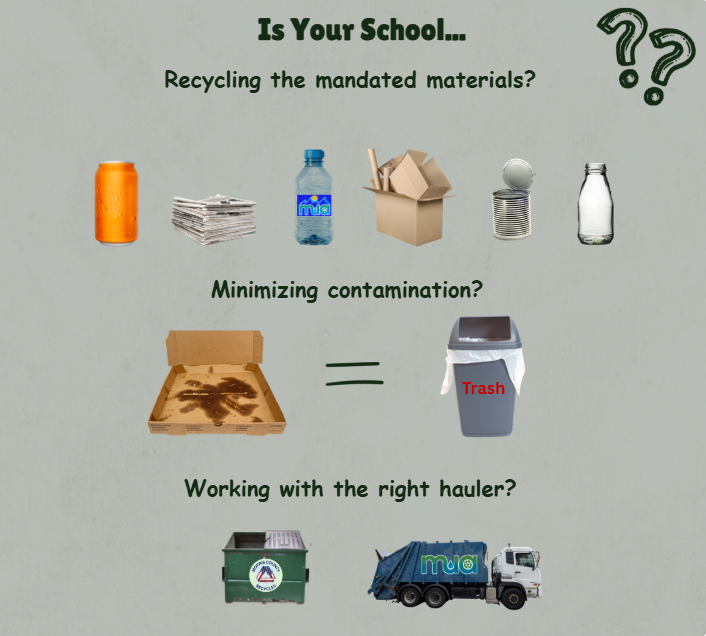
Schools are institutions under these laws, so these mandates apply to them directly. This means they must source separate their recycling, comply with e‑waste rules, etc.
Mandatory Source Separation and Recycling Act – NJ law (13:1E‑1 et seq) Requires all New Jersey counties to develop solid waste management plans, which include recycling plans. The law mandates that at least three designated recyclable materials, plus leaves, must be separated from the municipal solid waste stream. The exact list of mandated materials varies by county and sometimes by municipality.
Electronics Waste Management Act- NJ law (13:1E-99.94 et seq.) Mandates the establishment of a free recycling program for computers, monitors, laptops, portable computers televisions, desktop printers and fax machines. These programs are required to be established and funded by all the manufacturers that produce this equipment for residents, schools, institutions and businesses with under 50 employees. Computers, monitors, laptops, portable computers, printers and fax machines and televisions are banned from being disposed of in the garbage.
Food Waste Guidelines– NJ law (13:1E‑99.115) Requires the DEP, in consultation with the Departments of Education, Health, etc., to establish voluntary guidelines for schools and higher‑ed institutions to reduce, recover, and recycle food waste. These are voluntary, not yet mandated, but indicate upcoming policy direction. Read more about this law here!
Setting up recycling services is a critical first step in building a successful school recycling program. Commonly, the school business administrator’s role is to coordinate with the district’s facilities team and work with the school’s waste hauler to ensure services comply with local and state requirements. Begin this process by confirming which materials must be recycled in your area and whether your current hauler accepts them. If not, consider revising your contract or exploring alternative providers. Request precise details about pickup schedules, accepted materials, contamination policies, and reporting options. Be cautious if a hauler accepts only a limited set of items, as this may not meet regulatory standards. A well-structured recycling agreement helps your school divert waste from landfills and avoid fines or rejected pickups.
Before expanding or improving your recycling program, take time to understand what’s already in place. Review existing waste and recycling services, the materials collected, and whether all mandated items are included, both county and municipal. If you’re unsure, contact your hauler or district facilities coordinator for a copy of your service agreement.
Once you’ve assessed your current practices, collaborate with your hauler to ensure your recycling system meets all local requirements. Confirm exactly which materials they collect and whether they operate single-stream (all recyclables together) or dual-stream (sorted by type). Ask about bin sizes, pickup frequency, contamination policies, pricing, and whether they provide educational materials or recycling reports. Ensure their services include all required materials. If not, revisit your contract or explore other options.
Consider whether partnering through a shared services agreement could be a cost-effective option. Under the Local Public and Public School Contracts Law, boards of education are classified as local units. They may enter into contracts with other local entities, such as the Morris County Municipal Utilities Authority or a municipality, to provide or receive services, such as recycling and solid waste collection. These agreements are exempt from public bidding requirements and may extend for up to five years, offering both financial and administrative efficiencies. Before proceeding, boards of education should consult their legal counsel to determine if a shared services agreement is the best fit for their school’s needs.
Understand your local recycling laws
Review your recycling service agreement
Ensure your hauler complies with local recycling laws
Learn what recyclables your hauler accepts
Learn if your hauler collects single-stream or dual-stream
Create recycling protocol based on what your hauler collects
Ensure recycling protocol is shared with both students & staff
Ask if your hauler provides signage/educational resources